
Start a conversation
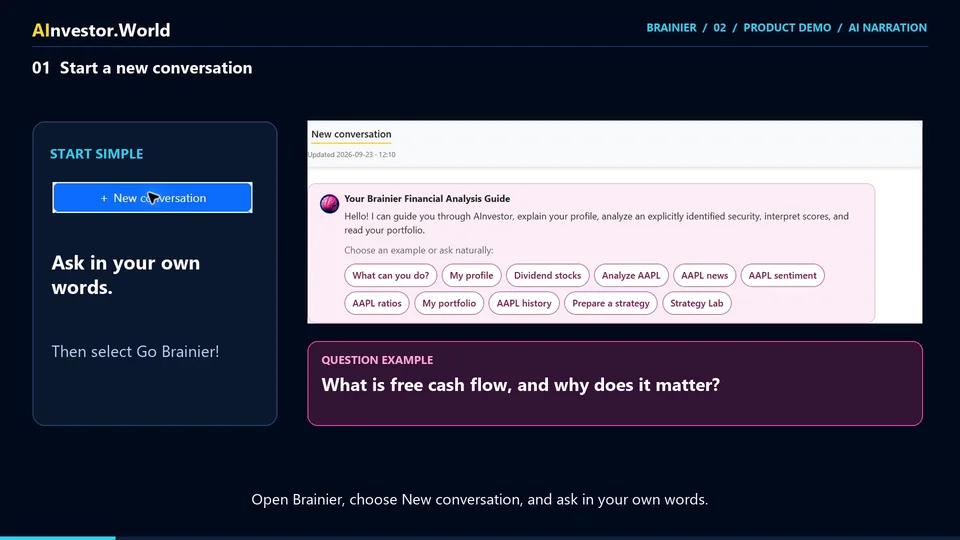
Open Brainier and select New conversation. Try: “What is free cash flow, and why does it matter?”

Invest Smartly
02 / Free chat
Start with a concept, ask in your own words and make the next question more precise.
The video will be available here soon. You can already explore the steps and read the complete narration below.
Open Brainier and select New conversation. Try: “What is free cash flow, and why does it matter?”
Stay in the same conversation. Ask how free cash flow differs from net income, or request three short bullet points.
Open Read fullscreen, review the explanation, then return to the conversation. Use a company report when your question needs company-specific context.
Complete English narration. Open a section to read at your own pace.
A good research question does not need to be complicated. Open Brainier, choose New conversation, and ask in your own words. Here, we ask what free cash flow means and why it matters when researching a company.
Brainier explains the concept in plain language. Free cash flow is the cash remaining after operating cash flow covers capital spending. It can help a company fund reinvestment, repay debt, or support dividends. It is one part of the financial picture, not a complete conclusion.
Keep the same conversation and make your next question more precise. We ask how free cash flow differs from net income, and request three short bullet points. You can ask for simpler wording, a definition, or a clearer explanation of an unfamiliar ratio.
Open Read fullscreen to give the answer more space. Here, Brainier separates accounting profit, non cash expenses, and cash availability. Read at your own pace, then return to the conversation. For a specific company, move to its report so that the next discussion includes that context.
FROM LEARNING TO EXPLORING
Create a free account to explore public companies, financial reports and your research questions.
Educational financial research tools. No personalized investment advice. Check reporting periods, available sources and data coverage.